Your first period: what to expect and how to be ready
Most girls get their first period between 10 and 15. What it looks like, how to use a pad, what’s normal in the first few years, and when to tell an adult or see a doctor.
Written by: Siratul Jannat (BMDC A-109809) · Medically reviewed by: Siratul Jannat (BMDC A-109809)
Your first period is a sign that your body is growing up the way it should. It isn’t an illness, and there is nothing shameful or impure about it. If nobody has explained it beforehand, it’s natural to feel scared the first time, so here is what will happen and what to do.
When does it start?
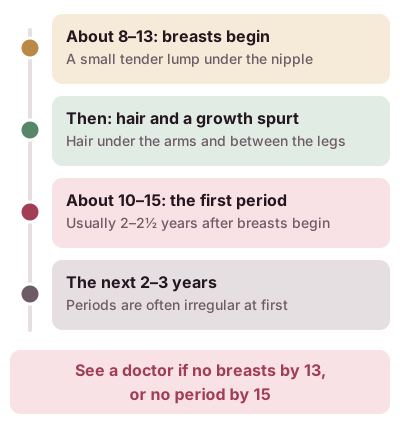
Most girls have their first period between 10 and 15, often around 12. It usually comes two to two and a half years after your breasts start to grow. For a few months before, you may notice white or pale yellow discharge in your pants; that’s normal too. Starting before or after your friends is nothing to worry about.
What does it look like?
The first time, you may only see a few brown or red spots in your pants. A period lasts 2 to 7 days. It can look like a lot, but the whole period is only a few spoonfuls of blood. Mild pain in the lower belly or back, tender breasts and feeling low or irritable are all normal.
Be ready
- Keep a pad and a spare pair of pants in your school bag.
- Change your pad every 4 to 6 hours, or sooner if it’s heavy. Wrap the used pad in paper and put it in the bin; don’t flush it.
- A clean cloth works too. Wash it with soap and cold water, dry it in the sun, and keep it somewhere clean and dry. Damp cloth can cause infections.
- Wash the outside of your private parts with plain water once or twice a day. You don’t need soap inside or any special wash.
- Bathing, washing your hair, going to school and playing sport all carry on as normal. You don’t need to avoid any food: fish, eggs and sour things are all fine.
The first two or three years
At first your period may not come at the same time every month. The body takes a while to settle, so a gap of anything from 21 to 45 days is normal, and sometimes a month or two is skipped. Write down the date each period starts; after a few months you’ll see your own pattern.
Tell your mother, an older sister or a teacher, and see a doctor, if
- You’re 15 and your periods haven’t started, or you’re 13 and your breasts haven’t started to grow
- Bleeding lasts more than 7 days, or soaks a pad in an hour or two
- Pain keeps you home from school even after a painkiller
- Periods keep coming sooner than every 21 days
- You always feel tired, dizzy or out of breath
Remember
Your body belongs to you. If anyone touches your private parts or makes you feel ashamed of your body, tell an adult you trust. You can also call 109 (the helpline for violence against women and children) or 1098 (the child helpline) for free.