"She'll never have children," her aunt said. Anika's PCOS, and how she took charge
Anika, 20, had periods every two to four months, acne and facial hair, and a relative's cruel prediction. The diagnosis was PCOS. With lifestyle changes and the right treatment, she felt in control again.
Written by: Siratul Jannat (BMDC A-109809) · Medically reviewed by: Siratul Jannat (BMDC A-109809)
The comment that hurt most came from an aunt at a family wedding: "That girl will never have children." After that, Anika stopped going to family events.
She was 20, at university in Dhaka. Since her teens her periods had come only every two to four months. Over two years she'd put on weight around her waist, developed acne along her jaw, and noticed dark hair on her chin and upper lip, along with dark, velvety skin on the back of her neck.
Her gynaecologist took a careful history, examined her, and ordered blood tests (hormones, thyroid, prolactin, sugar and cholesterol) and an ultrasound. The diagnosis was polycystic ovary syndrome (PCOS).
What PCOS is
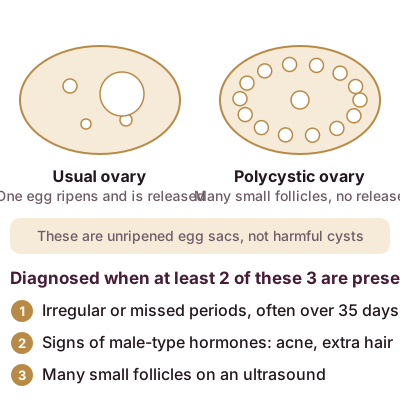
- A common hormone condition, diagnosed when at least two of these are present and other causes are ruled out: irregular or absent ovulation (irregular periods); signs of high male-type hormones (acne, extra hair, thinning scalp hair); and many small follicles on the ovaries on a scan.
- The "cysts" aren't true cysts; they're small follicles that didn't release an egg.
- Insulin resistance is central to it, and South Asian women are more prone to it, even at a normal weight.
The aunt was wrong
Most women with PCOS can get pregnant, some naturally, some with simple treatment to help ovulation. It's one of the most treatable causes of infertility.
Anika's plan
- Lifestyle: smaller portions of rice, more vegetables and protein, fewer sweets and soft drinks, and a 30-minute walk five days a week. Losing just 5 to 10 percent of body weight can bring periods back.
- Regular periods: the combined pill, to regulate periods, protect the womb lining, and help acne and hair. (When periods are very infrequent, the lining needs protecting with hormones.)
- Metformin for some women, to help insulin resistance.
- Hair and skin: acne treatment and hair removal, with prescription creams or tablets if needed.
- Long-term checks: blood sugar, blood pressure, cholesterol, and mood, since PCOS raises the risk of diabetes and is linked to anxiety and depression.
Six months on
Anika had lost 5 kg, her periods were coming monthly on the pill, and her skin was clearer. Most of all, the shame had gone. "PCOS is a condition, not a curse," she said.
See a doctor if
- Your periods are more than 35 days apart, or you have fewer than 8 a year
- Acne, extra hair or thinning hair are bothering you
- You've been trying to conceive for a year (or six months if you're over 35)
This story is illustrative. Names, places and details are made up; it is not about a real patient.