Her in-laws blamed her. Nobody asked about the period pain that made her faint
After three years without a pregnancy, Sharmeen's in-laws blamed her. Her husband's semen test was normal, and her periods were so painful she missed work. A laparoscopy found endometriosis and scar tissue. After treatment, she conceived. Why painful periods deserve attention.
Written by: Siratul Jannat (BMDC A-109809) · Medically reviewed by: Siratul Jannat (BMDC A-109809)
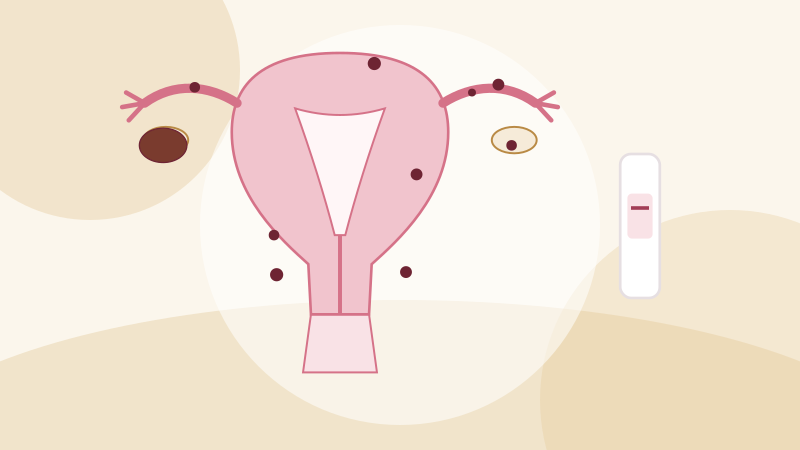
Three years into her marriage, with no pregnancy, Sharmeen's in-laws were hinting that her husband might marry again. What nobody asked about was her periods.
Sharmeen, 29, a pharmacist in Mymensingh, had had terrible period pain since her teens. Some months she vomited, or fainted, and she took painkillers for days at a time. Sex hurt too, deep inside.
Tests for both of them
Her gynaecologist started with the basics, for both partners:
- Her husband's semen test: normal. (Male factors cause, or add to, roughly a third to a half of cases, which is why this test comes early.)
- Her ovulation: a mid-cycle hormone test and scans showed she was releasing eggs.
- Her tubes: an X-ray dye test (HSG) suggested the left one was blocked.
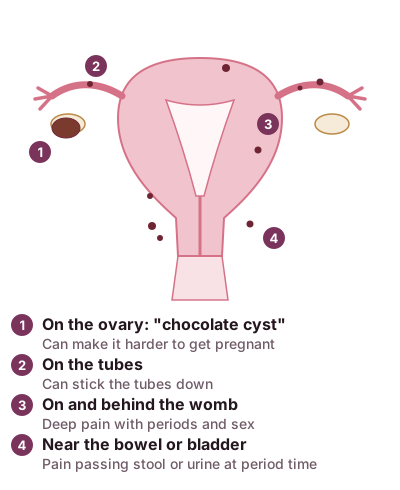
Because of the pain and the tube result, she was offered a laparoscopy, keyhole surgery. It found patches of endometriosis on her ovaries and the lining of the pelvis, and bands of scar tissue (adhesions) holding her left tube and ovary against the side wall.
What endometriosis is
- Tissue like the lining of the womb grows outside it, on the ovaries, tubes and the lining of the pelvis. It bleeds with each cycle, causing inflammation, pain and scarring.
- It's very common, affecting about 1 in 10 women of childbearing age. Diagnosis is often delayed for years, because period pain is treated as "normal".
- It can reduce fertility by distorting the tubes and ovaries, but many women with endometriosis do get pregnant.
Sharmeen's treatment
In the same laparoscopy the surgeon removed the endometriosis and freed the adhesions; afterwards the dye test showed both tubes open. She was advised to try naturally for 6 to 12 months. Eight months later she was pregnant. Had that not worked, the next step would have been IVF.
Pain treatment, if you're not trying to conceive
- Anti-inflammatory painkillers
- Hormonal treatment: the combined pill, progestogen tablets, the hormonal coil, or injections
- Surgery, for severe disease
See a doctor if
- Period pain stops you working or studying, or painkillers don't help
- You have deep pain during sex, or pain opening your bowels or passing urine during periods
- You haven't conceived after 12 months of trying (6 months if you're over 35, or sooner if your periods are very painful or irregular)
Infertility belongs to the couple. It is never one person's fault.
This story is illustrative. Names, places and details are made up; it is not about a real patient.