Cervical cancer can be prevented: VIA screening and the HPV vaccine
Cervical cancer is the second most common cancer in Bangladeshi women, and also one of the most preventable. Free VIA screening every 5 years from 30, and the HPV vaccine for girls, can stop it.
Written by: Siratul Jannat (BMDC A-109809) · Medically reviewed by: Siratul Jannat (BMDC A-109809)
Cervical cancer grows in the cervix, the neck of the womb. It's one of the commonest cancers among women in Bangladesh, and studies show that many women have never even heard of it. The message, though, is a hopeful one: it is one of the most preventable cancers there is, through vaccination and screening.
What causes it
Almost all cervical cancer is caused by a long-lasting infection with certain types of human papillomavirus (HPV), a very common virus passed on through sexual contact. Most HPV infections clear by themselves. In a few women the infection hangs on and slowly changes the cells of the cervix over 10 to 20 years. Screening finds those changes early, when treatment is simple.
Warning signs
Early changes cause no symptoms at all, which is exactly why screening matters. See a doctor if you have:
- Bleeding after sex
- Bleeding between periods, or after menopause
- A discharge that keeps smelling bad or is blood-stained
- Pain in the lower belly or during sex
Screening: the VIA test
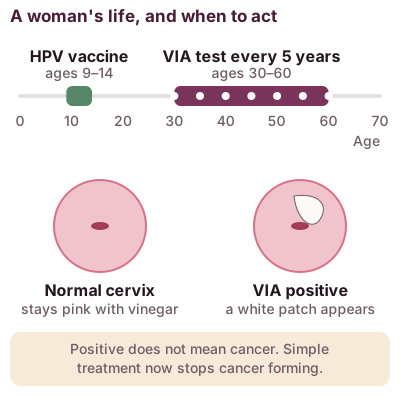
- For women aged 30 to 60, every 5 years
- Free at government health facilities, including many Union Health and Family Welfare Centres and Upazila Health Complexes
- A trained health worker dabs a mild vinegar solution on the cervix and looks for white patches. It takes a few minutes, it usually doesn't hurt, and you get the result the same day.
- Pap smears and HPV tests are also available, especially at private centres
If your VIA is positive
A positive VIA does not mean cancer. It means the cervix needs a closer look, usually by colposcopy. Early changes can be treated simply, often in a single visit, by freezing or heat treatment, and that treatment stops cancer from developing.
The HPV vaccine
The vaccine protects against the types of HPV behind most cervical cancers. It works best before any contact with the virus, so it's given to girls, usually aged 9 to 14. Bangladesh now includes HPV vaccination for girls in its national immunisation programme. Vaccinated girls still need screening when they're older.
Lowering your risk
- Get your daughters vaccinated
- Have VIA screening every 5 years from 30
- Don't smoke or use tobacco
- See a doctor promptly for any warning sign