Jahanara had never heard of a VIA test. Her daughter got the HPV vaccine
Jahanara, 45, had never been screened. Months of bleeding after sex turned out to be cervical cancer. Her story shows why screening every few years, and the HPV vaccine, can prevent most cases.
Written by: Siratul Jannat (BMDC A-109809) · Medically reviewed by: Siratul Jannat (BMDC A-109809)

Jahanara, from Jhenaidah, was married at 15 and has five children. At 45 she'd never had a cervical screening test; she didn't know such a thing existed. For about six months she'd had bleeding after sex, some bleeding between periods, and a watery, foul-smelling discharge. Ashamed, she started avoiding her husband.
When the bleeding got heavier she went to the district hospital. The doctor saw an abnormal growth on her cervix, and a biopsy confirmed cervical cancer.
What causes it
- Almost every case is caused by a long-lasting infection with high-risk types of human papillomavirus (HPV), a very common virus spread through sexual contact.
- Most HPV infections clear by themselves. In some women the virus stays, and over 10 to 20 years slowly causes pre-cancer changes before cancer develops.
- The risk is higher with early marriage, many pregnancies, smoking, HIV, and never being screened.
Jahanara's treatment
The cancer had spread beyond the cervix but was still within the pelvis. She was treated at a cancer hospital with radiotherapy and chemotherapy. It was a long road, and she completed it.
Screening finds pre-cancer, before there are symptoms
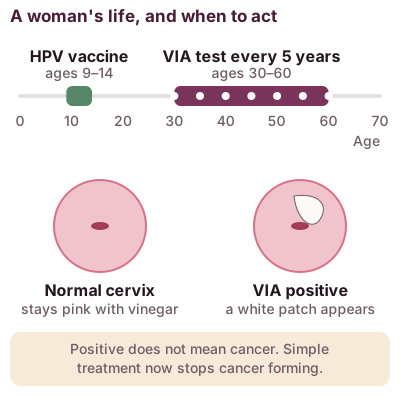
- VIA (visual inspection with acetic acid): a quick, painless test, free at many government health facilities in Bangladesh, for women aged 30 to 60.
- Pap smear and HPV testing, at hospitals and diagnostic centres. HPV testing is the most accurate.
- Pre-cancer can be treated in a few minutes in clinic (by thermal ablation or cryotherapy, for example), and that prevents cancer.
- Screen every 3 to 5 years, depending on the test, as your doctor advises.
Warning signs never to ignore
- Bleeding after sex, between periods, or after menopause
- A discharge that keeps being watery, blood-stained or foul-smelling
- Pain in the pelvis or during sex
The next generation
Jahanara's youngest daughter, who is 11, had the HPV vaccine in her school's vaccination campaign. It protects against the HPV types behind most cervical cancers, and works best before any sexual contact. "My daughter won't go through what I went through," Jahanara said.
This story is illustrative. Names, places and details are made up; it is not about a real patient.