Choosing a family planning method: a plain comparison
Implants and the Copper-T are the most effective reversible methods and last for years. Pills and injections work well if used on time. Condoms also protect against infections. The best method is the one that suits your life.
Written by: Siratul Jannat (BMDC A-109809) · Medically reviewed by: Siratul Jannat (BMDC A-109809)

Family planning lets you decide whether and when to have children, and to space them for your health and your baby's. Bangladesh has a strong family planning programme, and most methods are free at government family welfare centres.
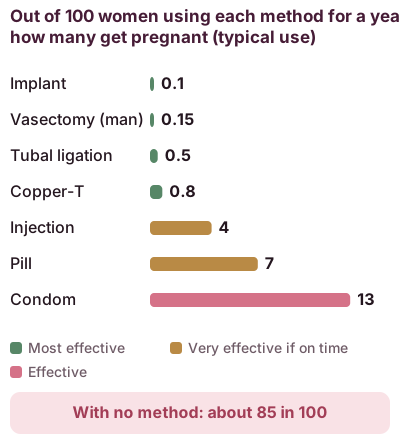
The chart shows how many women in 100 get pregnant in a year with each method as people really use it, missed pills and late injections included. The methods you don't have to remember every day, or every time, are the most reliable.
Long-acting methods: "fit and forget"
- Implant: a thin rod under the skin of the upper arm. Lasts 3 to 5 years depending on the type, and is over 99 percent effective. Periods may become irregular, lighter, or stop.
- Copper-T (IUD): a small device placed in the womb. Lasts up to 10 years, over 99 percent effective, no hormones. Periods may be heavier or more painful at first.
Short-acting methods
- Injection: every 3 months. Very effective if you go back on time. Periods often become irregular or stop. Fertility can take some months to come back after stopping.
- Combined pill: one a day. Very effective if you never miss, less so if you do. Often makes periods regular and lighter.
- Progestogen-only pill: one a day at the same time; fine while breastfeeding.
- Condom: every time. Also protects against sexually transmitted infections. Less effective if it isn't used correctly every time.
Permanent methods
Tubal ligation for women and vasectomy for men, for couples who are sure they don't want more children. Vasectomy is the simpler operation, and it doesn't affect a man's strength or his sex life.
Emergency contraception
After unprotected sex, the emergency pill, or a Copper-T fitted within 5 days, can prevent pregnancy. It's not meant for regular use.
Things to think about
- How soon you might want another child
- Whether you're breastfeeding
- Health conditions such as high blood pressure, migraine with aura, or a past blood clot
- How you'd feel about changes to your periods
- Whether you also want protection from infections
Myths
- "Contraception makes you infertile." It doesn't. Fertility comes back after stopping any reversible method.
- "A Copper-T can travel to your heart or stomach." It can't. Very occasionally it shifts within the pelvis, which is why a check after fitting is advised.
Talk it through with a doctor or family welfare visitor and pick the one that fits your life.