"Which one won't make me fat?" How Kakoli chose contraception after her second baby
Kakoli had heard that the pill causes infertility, the injection makes you fat, and the Copper-T wanders into the belly. Her family welfare visitor helped her sort myths from facts and choose a method that suited her life.
Written by: Siratul Jannat (BMDC A-109809) · Medically reviewed by: Siratul Jannat (BMDC A-109809)
Kakoli, 26, from Netrokona, had two children, aged three years and two months. She and her husband didn't want another baby for at least five years. But she'd heard so many stories: the pill causes infertility, the injection makes you fat, the Copper-T moves up into the belly, the implant in the arm causes cancer. Confused, she went to the Family Welfare Centre.
What the family welfare visitor asked first
- Are you breastfeeding? (Some methods are better while you are.)
- How long do you want to avoid pregnancy?
- Would you rather take something every day, every three months, or something long-term you can forget about?
- Do you have high blood pressure, migraines, or any other health problems?
- Which side effects would bother you most?
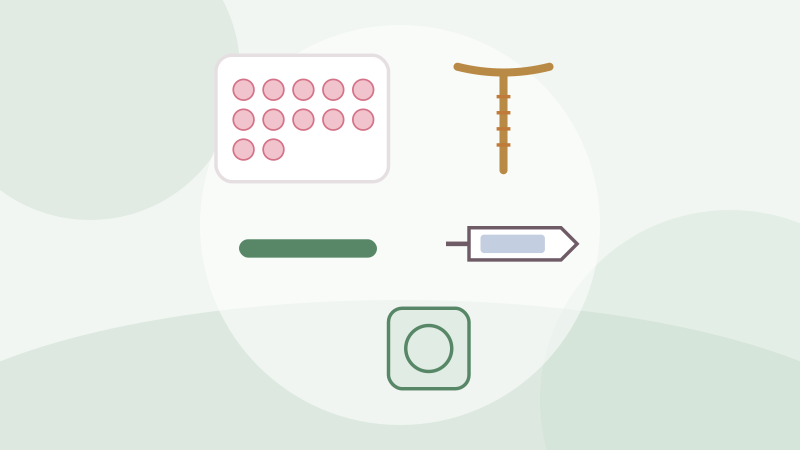
The options they went through
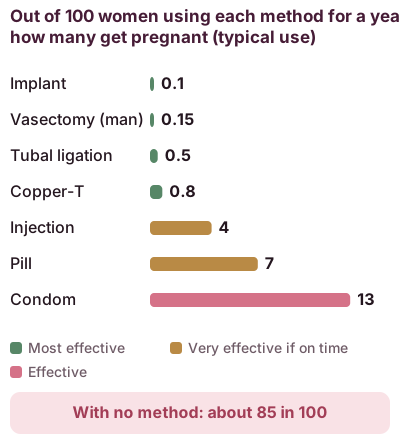
- Implant (a small rod in the upper arm): over 99% effective for 3 to 5 years. Safe while breastfeeding. Can cause irregular bleeding. Fertility returns quickly once it's removed.
- Copper-T (IUD): over 99% effective for up to 10 years, with no hormones. Can make periods heavier at first. It stays in the womb; moving into the belly is very rare. It can be fitted soon after a birth, or after 6 weeks.
- Injection, every 3 months: very effective if you're on time. Periods often stop, which isn't harmful. Some women put on a little weight. It can take several months for fertility to return after stopping.
- Progestogen-only pill: safe while breastfeeding, but must be taken at the same time every day.
- Combined pill: usually started once breastfeeding is well established, or after 6 months. Not for women with migraine with aura or high blood pressure. It does not cause infertility.
- Condoms: these also protect against infections.
- Breastfeeding as contraception (lactational amenorrhoea): works only if you're fully breastfeeding, your periods haven't come back, and the baby is under 6 months.
- Permanent methods, for the woman or the man (vasectomy is simple and safe), once the family is complete.
Kakoli's choice
She chose the implant: she wanted something long-acting that wouldn't affect breastfeeding. For the first few months her bleeding was irregular; she'd been told this is common and often settles. A year on, she was happy with it.
Myths and facts
- Contraception doesn't cause infertility. Fertility comes back after stopping, though after the injection it can take a few months.
- Pills don't build up in the body.
- The implant and the Copper-T don't cause cancer.
- Not having periods on the injection or the implant isn't dangerous.
Emergency contraception
After unprotected sex, emergency contraceptive pills work best within 72 hours (some work up to 120 hours). A Copper-T fitted within 5 days is the most effective emergency method of all.
This story is illustrative. Names, places and details are made up; it is not about a real patient.