Five years without a period, then a little pink spotting
Hosneara assumed her periods were coming back. Any bleeding after menopause needs checking; most causes are harmless, but some are early womb cancer, which is very curable when it's found early.
Written by: Siratul Jannat (BMDC A-109809) · Medically reviewed by: Siratul Jannat (BMDC A-109809)

Hosneara, 57, from Rajbari, had her last period five years ago. One day she noticed a little pink spotting, and a month later it happened again. She assumed her periods were coming back, and felt a bit embarrassed to mention it. It was her daughter-in-law, a nurse, who insisted she see a gynaecologist.
The doctor's first words were plain: "Any bleeding after menopause isn't normal, and it has to be checked. Usually the cause is something simple, but we need to be sure." Bleeding after 12 months without a period is called postmenopausal bleeding.
The tests
- An examination, including a look at the cervix and vagina
- A transvaginal ultrasound, to measure the thickness of the womb lining (endometrium). A thin lining makes cancer unlikely.
- Hosneara's lining was thickened, so the doctor took an endometrial biopsy, a small sample from inside the womb, right there in the clinic. A hysteroscopy can be used too.
The result
It showed early endometrial cancer, cancer of the womb. Because she'd come early, it was still confined to the womb. She had a hysterectomy, with both ovaries and tubes removed, and needed no further treatment. Her outlook is excellent.
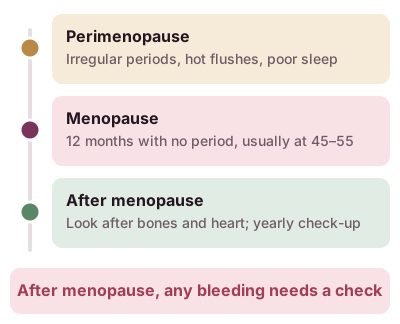
Common causes of bleeding after menopause
- Thinning and dryness of the vaginal lining (atrophy), the commonest cause
- Polyps in the womb or cervix
- A thickened womb lining (endometrial hyperplasia)
- Hormone treatment
- Less often, cancer of the womb, cervix or ovary
Who's more at risk of womb cancer
- Being overweight, diabetes, high blood pressure
- PCOS, never having been pregnant
- A late menopause, estrogen treatment without progestogen, tamoxifen
These days Hosneara tells her friends: "Don't be shy. Bleeding after menopause means see a doctor, even if it's only once."
This story is illustrative. Names, places and details are made up; it is not about a real patient.