Four days after her hysterectomy, a pain in her side and a fever
After her hysterectomy, Selima developed side pain, fever and a swollen belly. A scan showed urine blocked from one kidney. Injury to the ureter is an uncommon complication that can be repaired when it's found early. What to watch for after pelvic surgery.
Written by: Siratul Jannat (BMDC A-109809) · Medically reviewed by: Siratul Jannat (BMDC A-109809)
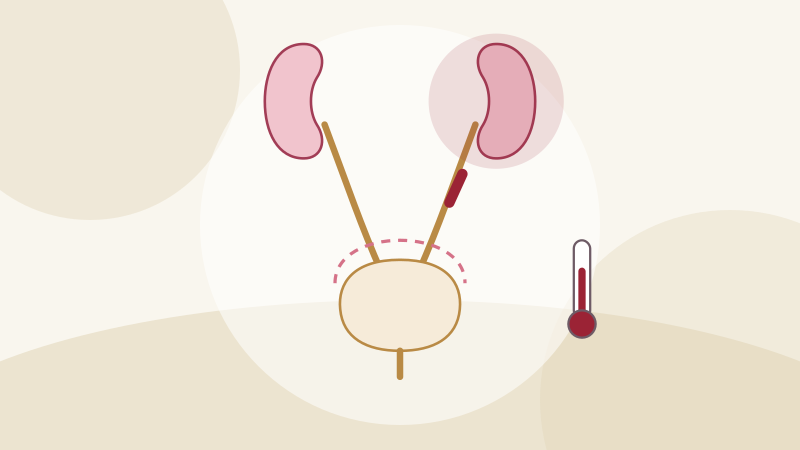
Selima, 46, from Munshiganj, had an abdominal hysterectomy for large fibroids. It was a difficult operation, because the fibroids were big and close to the side walls of the pelvis. On the fourth day afterwards she developed a dull pain in her left side and back and a fever, her belly felt swollen, and she was passing less urine than expected.
The surgical team ordered blood tests and an ultrasound, which showed her left kidney was swollen. A CT scan with contrast confirmed that the left ureter, the tube that carries urine from the kidney to the bladder, had been blocked during the operation.
Why the ureter can be injured
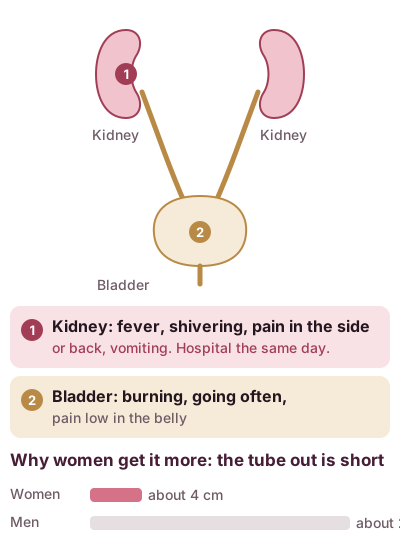
The ureters run very close to the womb, its blood vessels and the cervix. During a hysterectomy, especially with big fibroids, endometriosis, previous surgery, cancer or heavy bleeding, a ureter can occasionally be tied, cut or damaged by heat. It happens in a small percentage of hysterectomies, even with experienced surgeons.
Treatment
A urologist placed a thin tube (a stent) to drain the kidney, and later the blocked section was repaired. Selima recovered fully, and her kidney function returned to normal. Her surgeon explained honestly what had happened, which she appreciated.
Normal recovery after a hysterectomy
- Pain that gets a little better every day
- Light bleeding or discharge for a few weeks
- Tiredness for several weeks
Warning signs after any pelvic surgery
- Fever or shivering
- Pain in the side or back, or belly pain that's getting worse
- Passing much less urine, or none
- Urine leaking constantly from the vagina (a possible fistula)
- Heavy bleeding, or a bad-smelling discharge
- A swollen, painful leg, or breathlessness
Tell your surgeon, or go to hospital, the same day. Problems found early are easier to repair.
Questions to ask before an operation
- What are the risks of my particular operation?
- Is this a complex case that should be done in a larger hospital?
- Who do I call if something goes wrong after I go home?
This story is illustrative. Names, places and details are made up; it is not about a real patient.