"I feel fine, so why eight check-ups?" Rubina's first antenatal visit, far from home
Rubina, newly pregnant and living with her husband in Malaysia, planned to come home to Bangladesh just for the birth. A video call with her cousin, and her first visit, showed her why care from early pregnancy protects mother and baby.
Written by: Siratul Jannat (BMDC A-109809) · Medically reviewed by: Siratul Jannat (BMDC A-109809)
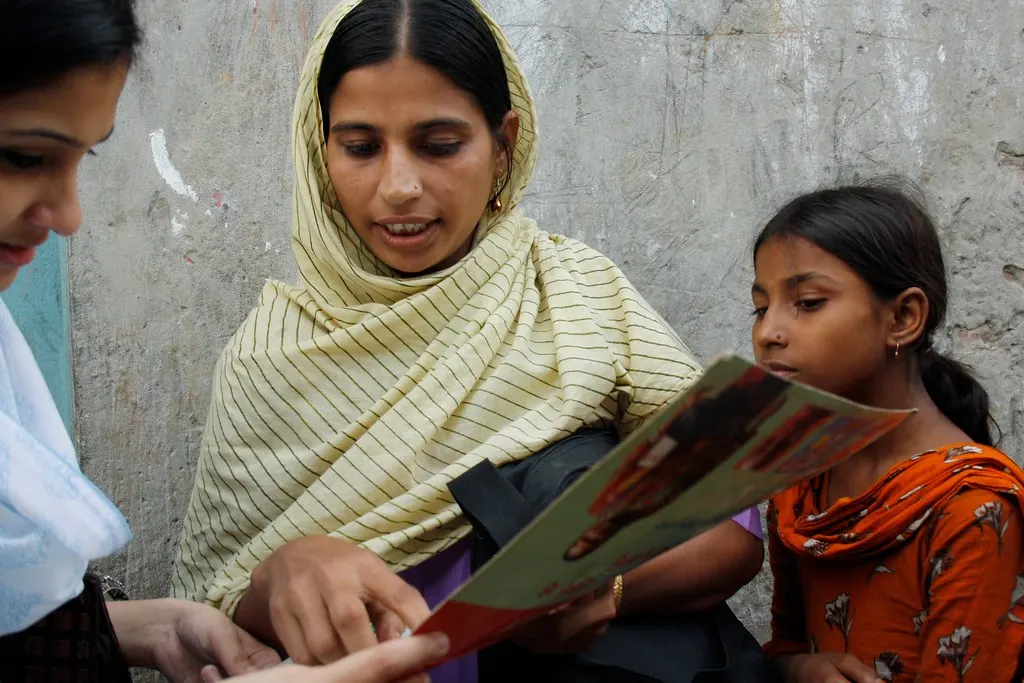
Rubina, 25, lived in Kuala Lumpur, where her husband worked. When her pregnancy test came up positive at six weeks, her plan was simple: fly home to Brahmanbaria at seven months for the birth, and see a doctor then.
On a video call, her cousin, a nurse, told her plainly: "Start your care now, wherever you are."
What happens at the first visit (around 8 to 12 weeks)
- Your history: the date of your last period, previous pregnancies, illnesses, medicines, and family history (diabetes, thalassaemia, twins)
- Measurements: weight, height, blood pressure
- Blood tests: blood group and Rh, haemoglobin, blood sugar, thyroid if needed, HIV, syphilis, hepatitis B, and thalassaemia screening if you haven't had it before
- Urine test: for infection and protein
- Ultrasound: to confirm the pregnancy is in the womb, see the heartbeat, count the babies and date the pregnancy
- A conversation about screening for Down syndrome, if you'd like it
How many check-ups?
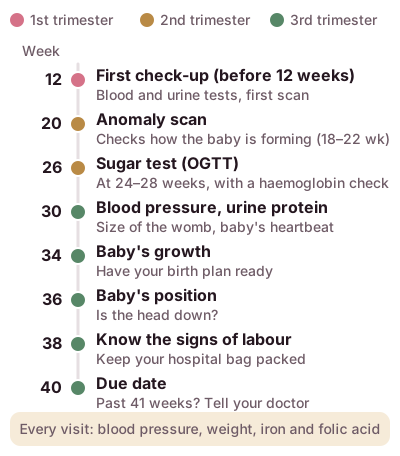
The WHO recommends at least eight contacts with a health worker in pregnancy: one in the first 12 weeks, two between 20 and 26 weeks, and five in the last three months (around 30, 34, 36, 38 and 40 weeks). Women with health problems, or twins, need more. Every visit checks your blood pressure and the baby's growth and heartbeat, and asks about warning signs.
The key scans and tests
- A dating scan in the first three months
- An anomaly scan at 18 to 22 weeks, to check the baby's organs
- A glucose tolerance test at 24 to 28 weeks for pregnancy diabetes (earlier if you're at higher risk)
- Haemoglobin checked again around 28 weeks
Supplements and vaccines
- Folic acid, ideally from before pregnancy and through the first 12 weeks
- Iron and folic acid every day, and calcium from 20 weeks, as advised
- Tetanus-diphtheria vaccine (TT/Td), on schedule
- The flu vaccine is safe in pregnancy
Danger signs: go to hospital immediately
- Bleeding from the vagina
- A severe headache, blurred vision, fits
- Fever, severe belly pain
- Your waters breaking
- The baby moving less
- A swollen face and hands, breathlessness
Tips for mothers living abroad
- Start your care in the country you live in, and keep copies of every report and scan, and your blood group.
- Check the airline's rules on flying late in pregnancy. Usually it's allowed up to 32 to 36 weeks, with a doctor's letter.
- Before you fly, choose your hospital in Bangladesh, plan how you'll get there, and register with the doctor who'll deliver your baby.
- Carry your records both on paper and on your phone.
Rubina started her care in Malaysia, flew home at 30 weeks with her reports, and gave birth to her son in Brahmanbaria at 39 weeks.
This story is illustrative. Names, places and details are made up; it is not about a real patient.