Sumaiya's first labour, hour by hour
Everyone had a frightening birth story for Sumaiya. Following her from the first cramps to holding her son shows what normal labour actually looks like, what helps, and the signs that something isn't right.
Written by: Siratul Jannat (BMDC A-109809) · Medically reviewed by: Siratul Jannat (BMDC A-109809)

By the time Sumaiya was 21 and pregnant for the first time, she had heard every frightening labour story in Mymensingh. Her midwife at the Upazila Health Complex had a simple suggestion: "Let's walk through what normally happens, step by step, so nothing surprises you." Here's how it went.
Early labour: the first 8 hours or so
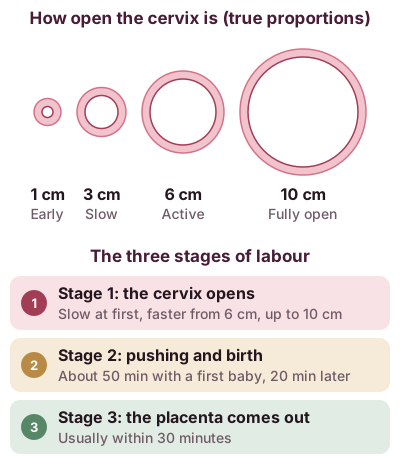
At 39 weeks, Sumaiya felt period-like cramps every 20 minutes, with backache, and passed a little blood-stained mucus, the "show". The midwife had told her this early phase can go on for many hours, especially the first time, and that it's fine to stay home, eat light food, drink water, walk and rest, as long as there's no bleeding, the waters are clear and the baby is moving.
Active labour: time to go in
By evening the contractions were coming every 4 to 5 minutes, each lasting about a minute. Sumaiya and her mother went to the hospital, where she was 5 cm open. From then on the midwife charted her progress on a partograph, checking the baby's heartbeat regularly, her blood pressure, and how the cervix was opening. In a first labour, the cervix often opens about 1 cm an hour, or a little slower, at this stage.
What helped
- Her mother beside her the whole time. Having a companion you choose is your right, and it makes labour easier.
- Walking, changing position, leaning forward through contractions
- Slow breathing, a back rub, sips of water and juice
- Passing urine regularly
- Knowing the pain relief options, which the midwife had explained
Pushing
Around midnight she felt a strong urge to push, and the midwife confirmed she was fully open, 10 cm. She pushed with each contraction in whatever position felt right. About an hour later her son was born and laid straight on her chest, skin to skin.
The placenta
Just after the birth she was given an oxytocin injection, which helps the womb contract and prevents heavy bleeding. The placenta came a few minutes later; the midwife checked it was complete and rubbed her belly to keep the womb firm. Sumaiya started breastfeeding within the first hour.
When labour isn't going normally
- Labour lasting more than 12 hours, or the cervix not opening on the partograph
- Heavy bleeding, green or bad-smelling waters, fever
- The baby's heartbeat becoming too slow or too fast
- A severe headache, blurred vision or fits
These need a doctor, and sometimes a caesarean, which is exactly why giving birth with a skilled attendant, in a facility, is safest.
"Because I knew each stage," Sumaiya said, "every new feeling didn't frighten me. And having my mother there made all the difference."
This story is illustrative. Names, places and details are made up; it is not about a real patient.