Bright red bleeding at 32 weeks, and no pain at all
Shirin woke to a bed wet with blood, though nothing hurt. Her placenta was lying over the opening of the womb. Why painless bleeding late in pregnancy is an emergency, and why nobody should examine inside at home.
Written by: Siratul Jannat (BMDC A-109809) · Medically reviewed by: Siratul Jannat (BMDC A-109809)
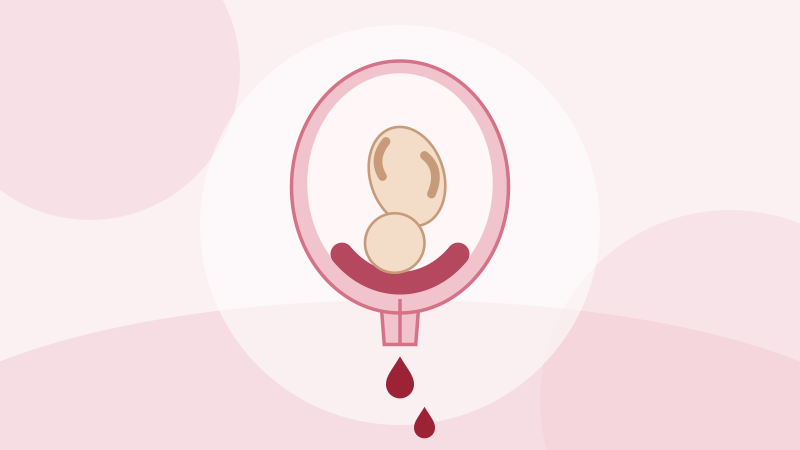
It was barely light when Shirin's husband found her sitting on the edge of the bed, staring at the sheet. It was soaked with bright red blood. Shirin, 31, from Bogura, was 32 weeks into her third pregnancy; both her older children had been born by caesarean. "It doesn't hurt," she kept saying. A neighbour who came over suggested they wait and see if it stopped.
Her husband didn't wait. He found a CNG and took her to the district hospital.
What happened at the hospital
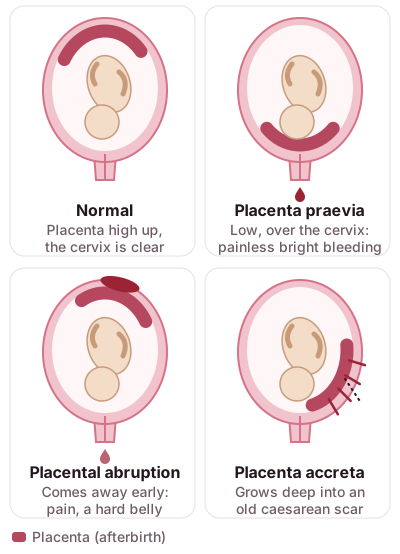
The doctor checked her pulse and blood pressure, put up a drip and listened to the baby's heartbeat, which was normal. What she did not do was an internal examination. Instead, an ultrasound showed the reason for the bleeding: the placenta was lying low, right over the opening of the womb. This is placenta previa.
"When the placenta covers the cervix," she explained to the couple, "it can bleed as the lower part of the womb stretches in the last months. Typically there's no pain, and the bleeding can be heavy. A finger examination inside can make it much worse, so after 20 weeks, if there's bleeding, nobody, not even an experienced dai, should examine inside."
She also looked carefully on the scan for placenta accreta, where the placenta grows too deeply into an old caesarean scar, because previous caesareans make both conditions more likely. And because the baby was only 32 weeks, Shirin was given steroid injections to help the lungs mature, in case the baby had to be born early.
The plan
- Stay in hospital until the bleeding settles
- Afterwards, live close to a hospital that can do a caesarean at any hour, with blood available
- Two relatives with her blood group agreed to donate if needed
- No sex, and come in immediately with any further bleeding
- A planned caesarean at around 36 to 37 weeks, since a normal birth isn't possible when the placenta covers the cervix
Go to hospital immediately if
- You have any bleeding after 20 weeks, even painless, even a little
- You bleed with pain or a hard, tight belly (this can be placental abruption)
- Your baby is moving less
Shirin had one more small bleed at 34 weeks and came straight in. At 36 weeks her daughter was born safely by caesarean. Her advice to other mothers was short: "Painless doesn't mean harmless. Go to the hospital first, and ask your questions afterwards."
This story is illustrative. Names, places and details are made up; it is not about a real patient.